
'At 1.58% of GDP, the defence budget is one of the lowest since the Chinese aggression of 1962.' 'The government of the day has lost sight of the fact that defence of the country is as important as its growth,' says Brigadier S K Chatterji (retd).
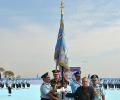
Cautioning against various threats facing the subcontinent, President Pranab Mukherjee on Friday said it was imperative for India to have an effective deterrence and strong defence to promote development and it must be prepared to use its "might" if the need arises.

'Let people across the LoC see the resolve of Bharat and the contribution of the Indian Security Forces in rebuilding the Valley. Let disaster become the rallying point for integration -- not only of society but also of all the instruments of State,' says General Anil Chait (retd).
'Jihadi outfits backed by the ISI are now prepared to attack targets not just in J&K, but also in Punjab. This signals an escalation in the range and scope of cross-border terrorism, which cannot be ignored,' says Ambassador G Parthasarthy, former high commissioner to Pakistan.

The Afghan deputy foreign minister explains how his nation's President became disillusioned with Pakistan. Ajai Shukla listens in.

'It was almost as though there was widespread relief that the defence bureaucracy, and the minister, could find someone willing to shoulder the blame for everything that had gone wrong with the services under Antony's charge -- the poor preparedness of the forces, slow acquisitions caused by indecision, cancellation of contracts and whimsical blacklisting of defence contractors over the tiniest suspicion that they may have paid speed money or kickbacks.'

'Ensuring through diplomatic means and in conjunction with strategic partners that India will not be required to fight a simultaneous two-front war with China and Pakistan.' Brigadier Gurmeet Kanwal (retd) lists what India must have in its national security strategy.
The National Democratic Alliance government has adopted half measures instead of moving decisively on defence.
'We should not minimise the seriousness of Chinese encroachments because their perception is different.' 'Nor should we fall into the trap of accepting so-called 'buffer zones' in areas of overlapping claims. We cannot have buffer zones in our own territory,' asserts Ambassador Shyam Saran, a former foreign secretary.
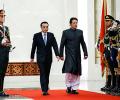
'Imran cannot escape responsibility for providing a mask to the Pakistan army to engage in unlawful activities and to wage aggression after India retaliated to the terrorist attack,' says Ambassador T P Sreenivasan.

'Pakistan's military leaders have to accept that the policy of proxy wars has damaged Pakistan more than it has damaged the enemy,' says former R&AW chief Vikram Sood.
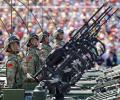
'Whether it is the One Belt One Road project or building relationships in the Indian Ocean Region -- supposedly our area of concern -- the Chinese are seriously outpacing us,' points out Vice-Admiral Premvir Das (retd).
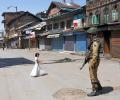
We must repeal AFSPA to begin to heal Kashmir, and to enhance India's moral stature and that of the army, says Ajai Shukla

'With the recent challenging of the notion of the Indian Ocean Region being India's strategic backyard, China is gradually upping the ante in the maritime realm around India.'
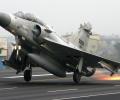
A realistic assessment will tell us that not much has changed between India and Pakistan; the relationship remains as fraught as before with little prospect of reconciliation, notes Ajai Shukla.
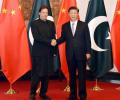
'The scheduling of Imran Khan's visit to Beijing and its focus on the J&K situation underscores that Beijing shares the Pakistani concern that tensions with India are only going to escalate further in the period ahead,' says Ambassador M K Bhadrakumar.

The allocation in the defence budget is inadequate to meet India's long-term threats, especially from China and Pakistan, says Gurmeet Kanwal.

'Why has the rhetoric gone down on the Indian side, Durrani wondered aloud.' 'I said because almost total normalcy and peace had returned on the ground in Kashmir,' recalls Shekhar Gupta. 'The general gave me that career spook's laser look. And he said: "That situation on the ground can change in no time".' 'This was precisely when the Pakistanis began their first incursions into Kargil.' 'Durrani had been retired for five years.' 'But once the ISI boss, you are always in the know.'

India and China met and spoke a lot this year, but failed to produce any meaningful results.
If he doesn't, two things are guaranteed: Failure for him, and continued slide for his nation despite its talented people, strong nationalism, the gift of geography and a formidable army, points out Shekhar Gupta.

Though dubbed as the 'war hero', the role of Rajapaksa in ending the conflict with the LTTE with the death of its supremo Velupillai Prabhakaran in 2009 is quite divisive as he stands accused of violating human rights, a charge he vehemently denies.
'According national security and higher defence management empathetic political attention they warrant is critical. Will Prime Minister Modi pick up this gauntlet?' asks C Uday Bhaskar.

'Intrusions by PLA troops in the Ladakh sector are more in number than elsewhere and this region is now likely to remain an area of enhanced Chinese interest,' warns China expert Jayadeva Ranade.

From Sri Lanka's most popular political family to its most despised -- going by the voices on the streets calling for the Rajapaksas' ouster -- what went wrong for the clan? Veteran Sri Lanka watcher N Sathiya Moorthy offers an insight.
'It seems likely that the February 2019 crisis is over.'

In the case of India, there are no specific references in China's white paper. However, there are several takeaways for India, says Srikanth Kondapalli.

The Bengaluru skies dazzled with somersaults and stunts by metal birds.
'We could quibble with each other whether there were 25 terrorists killed or 250 killed.' 'The message is more that India undertook such an aerial attack and this attack has actually changed the paradigm.' 'The change in paradigm is that India has shown by the surgical strike in 2016 and the aerial strike of 2019 that we will not just sit back and tolerate terrorism which killed so many of our people.' 'We will hit back and by hitting back we will raise the costs of such activities.'
'A conventional war is not in fashion today and not seen as being able to deliver the objective.' 'Perhaps surgical strikes that are deeper, this time not on Pakistan's terrorist facilities, but on Pakistan army facilities.' 'The nation has to be prepared for losses.' 'War is not something that can be pussyfooted around.' 'If we go for limited number of posts in Kashmir, these are very difficult posts to capture and very difficult operations.' 'Be prepared for 200 to 300 killed.'

'IAF is expanding at a rapid pace'

'The Panchsheel Agreement is unique in the annals of international relations as it stands out as a bizarre illustration of a prime minister trading his country's crucial national interests solely to buffer his personal international image,' feels R N Ravi.
In 28 months, Manohar Parrikar as defence minister developed easy relationships with the top brass of the three Services as was rarely ever witnessed before. He threw caution to the winds and managed to pull the forces out of a downward spiral in operational capabilities.
Indians must remember that Pakistanis hate losing to India, at war or in cricket, says Sanjeev Nayyar.

It will not be to India's advantage to create misperceptions that it is bandwagoning with some Anglo-American project for regime change in Myanmar, argues Ambassador M K Bhadrakumar.
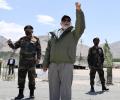
'Breaking down silos and ensuring a more integrated governance process is just as important to performance.' 'It has been a major priority in the last six years, especially in national security,' External Affairs Minister Dr Subrahmanyam Jaishankar points out when delivering the Sardar Patel Memorial Lecture-2020: India and the Post-Covid World.
'The government, supposedly manned by wise and experienced officers, was all at sea, unable to act cohesively, and with restraint. Each agency was out to score brownie points.'

Confronting a slowdown in growth, China says it will only increase its defence budget by 7.6% this year, against the anticipated rise of between 20% and 30%. 'It is difficult to explain the reduction in the Chinese defence budget,' says Claude Arpi. 'Is there a hidden budget? Possibly!'
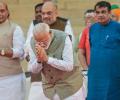
'I will need a few more pictures, sir, can I get some time from you for a more extended photo shoot?' asked Singh. Modi, ever-obliging before the camera, laughed. 'Sure, but let us plan to do it after my swearing-in is over in May!' The Balakot effect was evident. A fascinating excerpt from Rajdeep Sardesai's 2019: How Modi Won India.

'We have leaders who would rather that we cohabit with the Indian Mujahedeen than fight terror, as long as the payoffs are there in the next polls... Obviously, we are not headed down the best route to keep terror at bay,' says Brigadier S K Chatterji (retd).

Experts trace the reasons for the 26/11 attacks to the Pakistan's military interest in three key areas: Kashmir, Afghanistan and nuclear armaments.
 © 2026 Rediff.com - Advertise with us - Disclaimer - Privacy Policy - Sitemap - Feedback - About us - Terms of use - Grievances